Tag: solar

  • Unveiling the Mysteries of Solar Panel Direction: Why Do Solar Panels Face South?

    Have you ever noticed how solar panels are always facing in the same direction? It’s not a coincidence or just for aesthetic purposes. There’s a science to it, interconnected with the path of the sun, the tilt of the Earth, and the quest for maximum energy production. So why do solar panels face south, and is it really the best direction? Let’s journey together to uncover the mysteries of solar panel direction.

    Short Summary

    • South-facing solar panels are the best for maximizing energy production in the Northern Hemisphere.
    • Alternative solutions like adding more panels, ground mounted arrays or panel trackers can help maximize efficiency if your roof isn’t south facing.
    • Calculating output based on roof direction is easy with helpful online tools and will give you maximum savings regardless of location and type of panel.

    The Science Behind South-Facing Solar Panels

    Ever wondered why solar panels are usually installed on a south-facing roof? It’s all thanks to our celestial neighbor, the sun. The sun’s path in the northern hemisphere plays a pivotal role in solar panel orientation. Solar panels face south to absorb the most sunlight throughout the year, making them ideal for maximizing energy production.

    But what if your roof doesn’t face south? Well, you might have to compromise on your solar panel production, especially if your roof pitch is steep. But fret not! Even if you can’t get the perfect south-facing solar panel installation, there are ways to maximize energy production. Pairing south-facing panels with a home battery backup system and ensuring they’re installed at the perfect angle can help you get the most out of your solar array.

    Sun’s Path in the Northern Hemisphere

    The sun’s path is a fascinating phenomenon that greatly influences the direction for solar panels. The tilt of the Earth’s axis is fixed at 23.5 degrees, causing the sun’s path to always stay south of the Tropic of Cancer, located at 23.5 degrees north of the equator. This is why solar panels face south to maximize energy production.

    But it’s not just about the tilt of the Earth’s axis. If you observe carefully, you’ll notice that the sun’s path changes throughout the year. During summer, the sun rises north of east and sets north of west. However, during winter, sunrise and sunset appear further south along the horizon. The sun is overhead at its highest point in the south throughout the day. This is why harnessing the power of the sun from solar panels by having them face south is the optimal direction. South-facing solar panels are more effective because they are able to capture more direct sunlight throughout the year, thanks to the sun’s path never shifting north of the Tropic of Cancer.

    Maximizing Energy Production

    The goal of any solar panel installation is to generate as much energy as possible. And this is where south-facing solar panels shine the brightest. They get the most sunlight throughout the day, making them the best choice for converting sunlight into energy.

    Why is this important? Because more sunlight translates to more renewable energy, which leads to better economics. Throughout the day, the sun rises in the east, moves to the right, culminates in the south before setting in the west. By having your solar panels face south, you’re ensuring they get the most exposure to the sun’s path, and therefore, produce the most energy.

    Comparing Solar Panel Directions

    Now that we understand why south-facing panels are the gold standard, let’s look at how other orientations fare. You might wonder, “What if my roof doesn’t face south? Is it still worth it to install solar panels? Let’s compare the efficiency and output of solar panels facing different directions, including:

    • Southwest
    • Southeast
    • East
    • West
    • North

    The solar panel direction can significantly impact their energy production and potential savings, especially if you’re dealing with Time-of-Use (TOU) billing, where utilities charge higher rates for electricity during peak times. To position solar panels effectively, the closer the panels are to facing south, the more solar power they produce, and the more savings you can enjoy.

    However, when peak electricity rates skyrocket to 3x or 4x, the ideal orientation for a solar array shifts to the southwest. But remember, the more you turn away from the south, the more energy production you’re likely to lose. That’s why it’s crucial to determine the best direction for solar.

    Southwest and Southeast-Facing Panels

    Let’s start by considering southwest and southeast-facing panels, as well as west facing solar panels. These solar panels are installed pointing towards the southwest, southeast, or directly west. While they don’t quite get the same level of sunlight as south-facing panels, they’re not far behind.

    These panels tend to generate about 8% less power than south-facing panels. This means that while they’re still a viable option, they may not provide as high a return on investment as their south-facing counterparts. So if you’re considering installing panels facing southwest or southeast, keep this 8% drop in power output in mind.

    East and West-Facing Panels

    Moving on to east and west-facing panels, these orientations see a more significant drop in output. Compared to south-facing panels on standard pitch roofs, east and west-facing panels see a 15% decrease in output.

    However, they can generate more energy when they’re mounted at less than 30 degrees. So, if your roof faces east or west, don’t fret! You can still generate a decent amount of energy, especially if you position the panels at less than 30 degrees.

    North-Facing Panels

    Lastly, let’s discuss north-facing panels. These panels are the least ideal in terms of orientation. North-facing solar panels get less direct sunlight than south-facing panels, leading to lower energy production.

    In fact, north-facing panels see a significant 30% drop in energy production compared to south-facing ones. So if you’re considering installing solar panels and your roof faces north, it’s important to keep this substantial decrease in mind.

    Roof Constraints and Alternative Solutions

    But what if your roof doesn’t face south, or any of the other directions we’ve discussed? Don’t throw in the towel just yet! There are still options for homeowners with non-south-facing roofs to maximize solar panel efficiency.

    If your roof faces north, solar panels installed there won’t be as productive as those on south, east, or west-facing systems. However, there are several alternative solutions, such as adding more panels, using ground-mounted solar arrays, or employing solar panel trackers.

    Adding More Solar Panels

    One simple solution to less-than-ideal roof orientation is to add more solar panels. By increasing the number of panels, you can balance out using more electricity by producing more solar energy, leading to potentially lower electricity bills.

    Of course, before adding more panels, it’s crucial to consider the associated costs and space requirements. After all, solar panels require a significant upfront investment, and not every property has the space to accommodate additional panels.

    Ground-Mounted Solar Arrays

    For those with ample property space, ground-mounted solar arrays may be the answer. These are solar panels that are set up on the ground instead of on a roof, and they have their own set of perks. Ground-mounted solar arrays offer:

    • Easier maintenance
    • More control over the direction and angle of the panels
    • Potentially higher energy capture
    • Avoidance of potential damage to the roof

    However, they can be pricier due to the extra materials and labor needed for installation.

    Solar Panel Trackers

    If you’re looking for a more advanced solution to maximize your solar panel efficiency, consider solar panel trackers. These systems improve a solar panel’s output by:

    • Keeping it directly exposed to the sun all the time
    • Boosting energy production by up to 40% compared to fixed solar systems
    • Adjusting the angle of the panels to follow the sun’s movement during the day, improving energy output and efficiency.

    However, they do come with a higher price tag. For instance, a standard 4 kW solar panel system might set you back around $11,400 after incentives.

    Types of Solar Panels and Their Efficiency

    After understanding the impact of direction on solar panel efficiency, let’s shift our focus to the types of solar panels available in the market. The two most popular types are polycrystalline and monocrystalline solar panels, and each has its own pros and cons in terms of efficiency and cost.

    While polycrystalline solar panels aren’t as efficient as monocrystalline ones, they are more affordable. On the other hand, monocrystalline solar panels are more efficient but come with a higher price tag. So, how do you choose between the two? Let’s break it down further.

    Polycrystalline Solar Panels

    Polycrystalline solar panels are a type of solar panel made from multiple crystalline silicon cells. While they’re not as efficient as monocrystalline solar panels, they’re definitely more affordable. These panels usually have an efficiency rating ranging from 13% to 16%.

    They are more budget-friendly because they are less efficient than monocrystalline solar panels, and thus they don’t require as many materials to manufacture.

    Monocrystalline Solar Panels

    On the other end of the spectrum are monocrystalline solar panels. Made from a single crystal of silicon, they’re the most efficient type of solar panel. Monocrystalline solar panels have an efficiency range of 15-25%, with the best panels reaching up to 23%.

    However, this superior performance comes at a cost. Monocrystalline solar panels are pricier than other types, but they’re worth it since they’re more efficient and can generate more electricity in the long run.

    Optimal Angle for Solar Panel Installation

    The direction isn’t the only factor when it comes to maximizing the efficiency of your solar panels. The angle at which the panels are installed plays a crucial role too. But how do you determine the best angle for your solar panel installation?

    The ideal angle usually matches the latitude of the site, usually between 30 to 45 degrees. If you want to be more precise, you can add 15 degrees to the latitude in winter and subtract 15 degrees in summer to get the best tilt angle. But there’s more to it than just latitude.

    Factors Affecting Optimal Angle

    The optimal angle for your solar panels is influenced by several factors. The latitude of your home, for example, directly impacts the best angle for your solar panels. If you live in Miami, Florida at 25.7617° N, your solar panels should be tilted at 25 degrees.

    Other factors like the pitch of your roof and the amount of shading on your property can also affect the optimal angle. For instance, the steeper your roof pitch, the better the angle for the solar panels. However, if your home is shaded by trees or other structures, you may need to adjust the angle to take the shading into account.

    Finding the Best Angle

    Determining the best angle for your solar panels involves a bit of observation and calculation. You’ll want to monitor the sun’s position throughout the day, as the best angle will vary depending on the time of day.

    There are also several online tools that can assist you in finding the best angle for solar panel installation. These tools provide information about where the sun is throughout the day and what angle would be optimal based on where you live.

    Calculating Solar Panel Output Based on Roof Direction

    After deciding on the optimal direction and angle for your solar panels, the next step is to calculate how much energy your panels are likely to produce. You can do this using a solar incidence angle formula or online tools like the SolarReviews calculator.

    The savings you could get depend on your specific location and type of solar panel. But remember, even with a less-than-optimal roof direction or angle, you can still harness the power of the sun and enjoy substantial savings.

    Summary

    In summary, understanding the impact of direction, angle, and type of solar panels on their efficiency is crucial for maximizing your energy production and savings. While it’s true that south-facing panels at a tilt angle matching your latitude offer the highest efficiency, other orientations and angles can still be viable options. With the right knowledge, proper considerations, and by leveraging online tools and technology, you can make the most of your investment in solar power. Remember, the sun is a powerful ally in the quest for renewable energy. Harness it well, and you’ll reap the rewards.

    Frequently Asked Questions

    Why more solar panels should be facing west not south?

    West-facing solar panels generate more energy closer to peak use times, helping you meet your electricity needs in the afternoon when usage starts to increase. With west-facing panels, you’re better able to take advantage of available sunlight and maximize your energy production.

    Does it matter which direction solar panels face?

    It does matter which direction solar panels face, since south-facing panels receive the most direct sunlight and generate the most energy.

    Do all solar panels have to face south?

    For the most efficient energy production, solar panels should be facing the true south. However, south-west and south-east facing roofs are still relatively effective. East and west facing roofs will generate around 15% less power.

    What happens if solar panels face north?

    North-facing solar modules won’t produce as much electricity as south-facing, but they can still generate power on sunny days. They are an effective solution for generating electricity when designed by a qualified solar engineer.

    What are the alternatives if my roof doesn’t face south?

    If your roof doesn’t face south, you can explore other options such as adding more solar panels, using ground-mounted solar arrays, or employing solar panel trackers to maximize energy collection.
  • Do Solar Panels Increase Home Value in 2023?

    Are you looking for a bright idea to boost the value of your home? Well, look no further than solar panels! In this blog post, we’ll uncover if solar panels increase home value and how they can potentially increase your home’s value, while also saving you money on energy costs. So strap in and get ready to soak up the sun as we dive into the world of solar-powered homes.

    Short Summary

    • Owning solar panels can significantly increase home value, while leasing may not.
    • The US is seeing an increased demand for solar homes with regional factors contributing to their value.
    • Financial considerations like tax credits and net metering benefits are key when buying or selling a solar home – get informed & maximize your savings!

    The Solar Panel Effect on Home Value

    Solar panels have been making waves in the real estate market in recent years, and for good reason. Installing solar panels on your home can not only help you save on energy costs, but also potentially increase your property’s worth. But how do solar panels manage to add such shimmering value to your home? The answer lies in two main factors: the type of solar system you have and the growing demand for solar homes.

    First, let’s talk about the type of solar system you have. Generally, solar systems can be owned or leased, and this can greatly affect the value that solar panels add to your home.

    Next, we’ll explore the growing demand for solar homes and how this can lead to higher market value for properties with solar installations. To better understand these factors, let’s dive into the details of owned versus leased systems and the market demand for solar homes.

    Owned vs. Leased Systems

    When it comes to solar panels, the choice between owning and leasing can make a big difference in the value they bring to your home. Owned solar panels are like a ray of sunshine, potentially increasing your home’s value by a significant margin. On the other hand, leased solar panels may not shine as brightly on your property’s value, as they could result in zero or even negative value added.

    Why is this the case? Well, when you own your solar panels outright, you reap the full benefits of the energy savings they provide, and these savings can be attractive to potential buyers. However, when you lease your solar panels, the new homeowner may be required to assume the lease or buy out the remaining term of the lease. This can be a turn-off for some buyers, as they may not qualify for the lease transfer or may not want to take on the additional cost.

    Market Demand for Solar Homes

    The popularity of solar power is on the rise, and this growing demand for solar homes can have a significant impact on property values. In states that have embraced solar energy, homes equipped with solar panels can fetch a premium price compared to those without solar installations.

    In fact, some of the sunniest solar markets in the US include California, Texas, Florida, North Carolina, Arizona, Nevada, New Jersey, Massachusetts, Georgia, and New York. Homeowners in these states can benefit from higher market values due to the increased demand for solar-powered homes and the state incentives for installing solar panels.

    Regional Factors Affecting Solar Home Value

    Now that we’ve explored the type of solar system and market demand, let’s shine some light on the regional factors that can influence the added value of solar panels on a property. State incentives, local electricity rates, and the solar potential of your property are all factors that can contribute to the increase in value that solar panels bring to your home.

    Let’s delve into these factors and see how they can impact your solar home value.

    State Incentives and Policies

    State incentives and policies can play a significant role in boosting the value of solar homes. By offering extra solar incentives and credits, states can help reduce the cost of installing solar panels, making them a more attractive investment for homeowners.

    For example, property tax exemptions, tax credits, and zoning regulations can all affect home values, but solar panels seem to be the talk of the town when it comes to these incentives. In states with supportive solar policies, homes with solar installations can enjoy higher market values due to the financial benefits provided by these incentives.

    Local Electricity Rates

    Local electricity rates can have a substantial impact on the value of solar panels for a home. In areas where electricity rates are high, homeowners can save more money by installing solar panels, which in turn can increase the property’s value.

    For instance, the cost of grid electricity can vary widely across different states, with Massachusetts paying 24.80 cents per Kilowatt-hour and Washington enjoying a lower rate at 10.17 cents per Kilowatt-hour in July 2022. By installing solar panels and reducing their reliance on grid electricity, homeowners in states with high electricity rates can enjoy more significant savings on their energy bills, which can lead to higher home values.

    Solar Potential and Sun Exposure

    Sun exposure and solar potential are crucial factors that can affect the value of solar panels on a home. The more sunlight that reaches your property, the more energy your solar panels can generate, resulting in lower energy costs and higher savings.

    There are several ways to determine the solar potential and sun exposure of a property, including using Google’s Project Sunroof, having a solar installer evaluate the property, calculating peak sunlight hours, and using a Sun Number Score.

    By ensuring that your property has high solar potential and sun exposure, you can maximize the benefits of solar panels, leading to an increase in your home’s value.

    Solar System Age and Condition

    Another significant factor that can influence the value of your solar-equipped home is the age and condition of your solar system. Let’s delve into the details of how the maintenance and efficiency of your solar panels, warranty coverage, and upgrade potential can all impact your home’s value.

    The maintenance of your solar system is an important factor in determining the value of your home. Regular maintenance and cleaning of your solar panels can help ensure that they are operating at peak efficiency. Additionally, having a strong relationship with the community is crucial.

    Maintenance and Efficiency

    A well-maintained solar panel system is essential for ensuring the panels’ efficiency and functionality, which can, in turn, have a significant impact on your home’s value. Dirty or damaged panels can reduce energy production, resulting in higher energy costs and lower property value.

    The National Renewable Energy Laboratory (NREL) reports that for every $1 saved on utility bills, a home’s value increases by $20, making solar panels a smart investment for savvy homeowners. By ensuring that your solar panels are in top shape, you can maximize their energy-generating potential and the resulting increase in your property’s value.

    Warranty Coverage

    Warranty coverage plays a vital role in affecting the value of a solar-equipped home. A comprehensive warranty can serve as a promise to potential buyers that the solar panels will continue to function efficiently for a certain period, making them feel more confident about investing in the home and increasing its value.

    A good solar panel warranty ensures that your panels won’t lose more than 10% to 20% of their power output capacity over the first 25 years. Providing the proper warranty paperwork when selling your home can help assure potential buyers of the solar system’s reliability and boost your home’s value.

    Upgrade Potential

    The potential for upgrading older solar systems can also increase your home’s value. Older or outdated solar panels can be less efficient and may require costly repairs and maintenance. By upgrading or adding more solar panels to your home, you can improve the system’s efficiency and increase its value.

    The National Renewable Energy Laboratory (NREL) states that every dollar saved on energy through solar panels increases home value by a whopping $20. When considering upgrading your solar system, be sure to weigh the costs and benefits of upgrading, including the potential increase in home value and the long-term energy savings that upgraded solar panels can provide.

    Financial Considerations for Solar Panels

    Installing solar panels on your home can be a smart financial decision, but it’s essential to understand the various financial aspects related to solar panels and their effect on home value. In this section, we’ll explore tax credits and rebates, net metering benefits, and financing options that can influence the value of solar panels on your property.

    Tax Credits and Rebates

    Tax credits and rebates can significantly affect the value of solar panels on your property. For example, if you installed a solar PV system in 2020 or 2021, you could benefit from a 26% tax credit. From 2022 to 2032, you can enjoy an even more substantial 30% tax credit. Additionally, state-level incentives and rebates can lower the cost of installing solar panels by up to 20%.

    These incentives can make solar panels more affordable for homeowners, and the premium that homebuyers are likely to pay for a house with an existing solar system is reduced with all the tax breaks and subsidies available. Therefore, it’s essential to consider the available tax credits and rebates when evaluating the financial benefits of installing solar panels on your home.

    Net Metering Benefits

    Net metering is a fantastic benefit for private solar panel owners, allowing them to return any excess energy they generate back to the electric grid. This arrangement can result in substantial utility bill savings, a faster solar payback period, and the ability to bank excess energy back to the grid.

    These net metering benefits can help increase the value of your solar-equipped home by providing additional financial incentives for potential buyers. Homeowners who take advantage of net metering can enjoy lower energy costs and higher savings, making their solar-equipped homes more valuable and attractive to prospective buyers.

    Financing Options

    Various financing options are available for purchasing and installing solar panels on your home. These options include paying cash, taking out a loan, leasing, or entering into a power purchase agreement. Each of these options has its own implications for your home’s value.

    For example, paying cash for your solar panels can provide the most direct and straightforward path to increasing your home’s value, while loans and leases can offer more flexible payment options with lower upfront costs.

    Understanding the financing options available to you and their potential impact on your home’s value can help you make an informed decision when choosing to install solar panels on your property.

    Selling and Buying Solar Homes

    Now that we’ve covered the various factors that can influence the value of solar panels on your home, let’s offer some advice for both sellers and buyers of solar homes. Understanding the value of solar panels and their impact on home value can help both parties make more informed decisions during the buying and selling process.

    For sellers, it’s important to understand the value of the solar panels and how they can impact the overall value of the home. It’s also important to consider the cost of installation and maintenance when pricing the home.

    Seller Tips

    As a seller looking to maximize the value of your solar-equipped home, it’s essential to highlight the financial and environmental benefits of solar power to potential buyers. Providing information on the solar installer, maintenance reports, and warranty documentation can further reassure buyers of the solar system’s reliability and efficiency.

    Additionally, collaborating with a real estate agent who is knowledgeable about solar homes can help ensure that your property is marketed effectively to potential buyers interested in the benefits of solar power. By emphasizing the advantages of your solar-equipped home, you can attract more buyers and potentially increase its value.

    Buyer Considerations

    As a buyer considering a home with solar panels, it’s essential to evaluate factors such as the age and condition of the solar system, the type of solar system (owned or leased), and the potential energy savings. Requesting the latest utility bills, warranties, and installation paperwork from the seller can help you make an informed decision about the value of the solar panels on the property.

    Additionally, working with a real estate agent who is familiar with solar homes can provide valuable insights and guidance during the buying process. By understanding the various factors that contribute to the value of solar panels on a property, you can make a well-informed decision when purchasing a solar-equipped home.

    Summary

    In conclusion, installing solar panels on your home can potentially increase its value, while also providing significant energy savings and reducing your carbon footprint. Factors such as the type of solar system, market demand for solar homes, regional factors, and the solar system’s age and condition all play a role in determining the added value of solar panels on your property. By considering these factors and understanding the financial aspects of installing solar panels, both sellers and buyers can make more informed decisions when it comes to solar-equipped homes. So, are you ready to harness the power of the sun and potentially boost your home’s value?

    Frequently Asked Questions

    Does having solar increase the value of your home?

    Yes, investing in solar panels has been found to significantly increase the value of your home. Studies have shown that homes with solar panels sell for 4% more on average and receive up to $5,911 extra for each kilowatt of installed solar energy.

    How long will it take for solar panels to pay for themselves?

    Your solar payback period could be as short as five years or as long as fifteen. On average, it’ll take about 10 years to break even after investing in solar panels.

    With some smart financing options, you could reap the rewards of clean energy sooner than you think!

    How do you value solar panels in an appraisal?

    When assessing the value of solar panels in an appraisal, it is important to take into account the location’s electricity usage and kilowatt hour rate. PV Value® can help assess the energy production needed, and the cost and income approaches can be used to develop a conclusion on the solar panel’s worth.

    How much value do solar panels add to a house?

    Solar panels are an appealing addition to any home, not only because they reduce energy costs and benefit the environment, but also because they increase the value of a house. According to Zillow’s study, solar panels can add an average of 4.1% to your home’s appraisal value. Plus, where you live and the strength of your local solar market can increase this value even more.

    So why not give your wallet and the planet a boost with a solar panel installation?

  • How Efficient are Modern Solar Panels?

    How Efficient are Modern Solar Panels?

    When making a choice to get or learn about solar panels, it is important to consider solar panel efficiency. More efficient panels will have a higher upfront cost, but they will also produce more electricity and offset more emissions.

    The average efficiency of solar panels today is 17-18 percent. The most efficient solar panels available range from 20-23 percent and on the lower end, some panels have only 15% efficiency.

    Solar panels offer a great way to reduce your carbon footprint and lower your electric bill. Solar panels are most efficient when installed on a south-facing roof that receives direct sunlight throughout the day. The angle of your roof and the amount of sunlight it receives will affect the efficiency of your solar panel system.

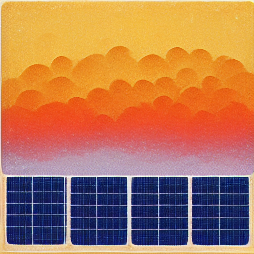
    Image of Solar Panel (generated by AI)
    Solar panel perspective (generated by AI)

    What is solar panel efficiency?

    Solar panel efficiency refers to the amount of sunlight that hits the solar panel and is converted into usable electricity. As an example, if the efficiency is 17%, this means that out of all the sunlight that hits a solar panel, only about 17% is converted into electricity.

    Solar efficiency is one of the most important factors to consider when choosing solar panels for your home. This refers to the amount of sunlight that is converted into electricity and the higher the efficiency, the more electricity you will get from the solar panel.

    Solar panels are rated by their efficiency, which is usually measured in a percentage. The higher the solar panel efficiency, the more solar energy will be converted into electrical energy.

    For example, a 22% efficient solar cell is going to give you more electricity at the end of the day than a 15% solar cell. This is assuming both panels have the same wattage.

    Solar panel efficiency is the percentage of solar energy that is converted into electrical power. The higher the efficiency, the more electricity you will produce.

    A solar system efficiency is determined by several factors, including the type of solar panel, the size of the solar panel, and the angle of the sun.

    The benefits of solar panel efficiency

    solar panels in front of sunset colored clouds

    There are several benefits to having a solar panel with high efficiency. An example of one of these benefits is saving money.

    • You will produce more electricity, which means you will save money on your energy bills.

    • You will need fewer solar panels to meet your energy needs which means you will save on installation costs.

    • A high-efficiency solar panel will last longer than a low-efficiency solar panel, so you will save money on maintenance costs.

    • Maximum efficiency solar panels are more environmentally friendly than a lower efficiency solar panel, because it requires less light energy to produce the same amount of electricity.

    The most efficient solar panels produce more electricity

    One of the biggest benefits of most solar panels’ efficiency is that you will save money on your electric bill. Solar panels are expensive, so you want to make sure that you are getting the most for your money.

    Abstract look of many solar panels

    How to choose solar cells with high efficiency

    There are two main types of solar cells: monocrystalline and polycrystalline. Monocrystalline panels are more effective than polycrystalline panels, and there are also thin-film solar panels which are the least efficient.

    • Monocrystalline cells are the most efficient.

    • Polycrystalline cells are less efficient.

    • Thin-film solar panels are the absolute least efficient, but they’re also the cheapest option.

    Think of these options as good, better, and best. Monocrystalline solar panels being the best money can buy.

    Monocrystalline solar panels

    Monocrystalline solar panels are the most efficient type of solar panel available on the market today. They are made from a single, large crystal of silicon and are cut into thin wafers to create solar cells.

    Monocrystalline solar panels have the highest solar cell efficiency level of any type of solar panel, typically around 20%. But there are some of these panels that have higher than 25 percent!

    Polycrystalline solar panels

    Polycrystalline solar cells are less efficient than monocrystalline solar cells, but they are also less expensive to manufacture. Polycrystalline solar panels are a good choice for homeowners who want to reduce their carbon footprint and save money on their electric bill.

    Thin film solar panels

    Solar panels are a great way to generate clean, renewable energy. However, traditional solar panels can be bulky and expensive. Thin film solar panels offer a more affordable and compact alternative.

    Thin film solar panels are made by depositing layers of photovoltaic material onto a substrate, such as glass or metal. Thin film solar panels are less efficient than traditional products, but they have many other advantages.

    Thin film solar panels are lighter and more flexible and can be installed on curved surfaces. They are also less expensive to produce than traditional solar panels. Sometimes these are installed on RVs or portable surfaces.

    They also tend to be less expensive than traditional solar panels, making them a more attractive option for consumers. As the world looks for ways to reduce its reliance on fossil fuels, thin film solar panels offer a promising solution.

    Generate more solar power with less panels

    Another benefit of solar panel efficiency is that you will [typically] be able to generate more electricity with less panels. Although this isn’t always the case, it’s a general fact.

    This is because solar panels produce the most electricity when they are directly in the sun. Higher efficiency equals generation of more electricity during the day, which creates more energy output.

    Panel Size Vs Efficiency

    Panel efficiency is calculated using power ratings divided into the total space within the panel, therefore, having bigger panels doesn’t always equate to greater efficiency.

    Larger panels with larger cells increase cell surfaces thereby increasing efficiency. Commercial and residential panels use larger format 72-cell panels. However, as described above the industry trend has exploded for much larger panel formats built around larger size cells that increase panel efficiency and increase Power Output by up to 650W!

    Cost Vs Efficiency

    Solar panel manufacturers offer various panel styles with varying efficiency ratings in accordance with their silicon types, as well as their integration with other cell technology, such as one called PERC.

    The most efficient panel above 22% can be very expensive. If cost is a major limitation it would be better suited to locations with limited mounting space. Otherwise, you may pay a premium for the same power capacity.

    Why does solar efficiency matter?

    The most important criteria when choosing a solar panel include efficiency and reliability as well as the manufacturers services and warranties.

    abstract image of many solar panels in grid

    Another thing to consider is the size of your solar panel. Larger solar panels will be more efficient than smaller solar panels.

    Don’t forget to look at the manufacturer’s specifications to see how efficient their solar panels are. The leading manufacturers are open with the specs for consumers to see.

    When you’re looking for a solar panel with high efficiency, it’s important to do your research and compare different options. There are a lot of great solar panels on the market today, and you’re sure to find one that fits your needs and budget.

    There are a few key factors to consider when selecting solar panels for your home or business in order to get the most efficient system possible.

    Remember that solar efficiency is a measure of how well a solar panel can convert sunlight into electricity. The higher the efficiency, the better the panel can generate electricity.

    Solar panel efficiency is important because it determines how much power you can generate from a given amount of solar panels. It also affects the cost of your total solar energy system, as more efficient panels typically cost more.

    What factors affect solar panel efficiency?

    The most efficient solar panels are those that are able to capture the most sunlight. South-facing roofs that receive direct sunlight throughout the day are ideal for solar panel installation. The angle of your roof and the amount of sunlight it receives will affect the efficiency of your solar panel system.

    beams of light
    beams of light

    Maximizing energy is crucial when it comes to [solar] photovoltaic panels. They are affected by a number of factors, including:

    • the angle of your roof – if it is too steep or too flat.

    • the amount of roof space – a more efficient panel might be able to help limited space.

    • the amount of sunlight it receives – more sunlight can create more electricity.

    • the type of solar panels that are installed – more efficient can mean more electricity.

    Solar panel efficiency

    Solar panels are designed to provide energy to the environment by reflecting sunlight on the surface. Because photovoltaic technology has evolved over the last decade the average panel conversion rate has increased 12% to nearly 30%.

    It has been seen that this big boost in efficiency result in a surge power rating for panel sizes from 250 watts to 400 and beyond.

    High efficiency pv cells are defined by two primary factors: the photovoltaic (PV) cell efficiency, the solar cell layout, and the silicon type.

    Which factors determine the efficiency of solar panels?

    Solar panels can typically convert 15%-22% solar power into usable electricity based on factors like position, orientation, and weather condition. Solar panels convert sunlight into electricity by generating electricity, and the output determines solar panels performance.

    Real-world efficiency

    The efficiency of a solar cell depends largely on external factors like depending on local environmental conditions, these different factors can decrease panel performance. The best solar panels can withstand harsh conditions without affecting operating efficiency.

    For some technical jargon, the major factors which affect panel energy efficiency include irradiance, shading, panel orientation, temperature locations (longitudes), and a couple of other technical factors.

    The factors that have the most significant impact of panel efficiency are irradiation (w/m2) and shading.

    The Efficiency of Solar Panels Under Extreme Conditions

    The National Renewable Energy Laboratory (NREL) has been working on building low cost, high-efficient solar cells that work well on the Earth’s surface or any place that has sunlight shining.

    If you aren’t familiar with the National Renewable Energy Laboratory, they try to find answers about to solve today’s energy challenges.

    At the National Renewable Energy Laboratory (NREL), we focus on creative answers to today’s energy challenges.

    From breakthroughs in fundamental science to new clean technologies to integrated energy systems that power our lives, NREL researchers are transforming the way the nation and the world use energy.

    Source: About NREL

    Extensive testing evaluations

    Solar panels have been evaluated for their efficiency so that they can not be sold in low-end markets. Companies must demonstrate that solar cells are long-lasting and efficient.

    Snow

    Snow is strong and dense. This will affect panels if over 5 cm of snow accumulate on solar panels reducing their efficiency.

    Tilted solar panels allow snow to slide off easily, but in cases that are not automatic the snow must be removed. Under winter conditions, solar panels can and will still flourish and produce electricity.

    Hail

    Hail tests involve shooting artificial hail with speeds of around 20 and 30 meters per second. Solar cells will not be damaged at this speed. According to National Renewable Energy Laboratory (NREL) analysis of more than 500,000 solar systems installed over the past five decades, the number of systems affected was 0.4%.

    UV Degradation

    In some solar cells they may become de-laminated by oxidizing sunlight. Other consequences may involve discoloring of solar cells. In the first 1,000 hours of exposure to the sun, panels may have formed boron oxide layers that reduce efficiency.

    Ice

    Ice can form on solar cell walls when there is no silicon coating. The build-in of ice could reduce the power output anywhere from 25 – 100%.

    Every consumer is not looking to buy solar panels that do not have technical integrity. There are many advantages to solar energy and a well planned and/or thought out installation is necessary. In order to ensure quality of solar panels they have been extensively tested in the most severe environments.

    Warmer climate benefits

    Warmer climates can benefit greatly by using high efficiency solar cells since these areas are naturally capable of fulfilling renewable energy needs. These climates can capture sunlight and solar systems don’t struggle with harsh weather like the cold.

    Summary about Solar Efficiency

    The benefits of solar panel efficiency are twofold. First, higher efficiency panels produce more electricity, which can save you money on your energy bills. Second, solar panel efficiency can help you reduce your carbon footprint by offsetting more emissions from traditional power sources.

    Finding the most efficient solar cells is an important factor to consider when you’re shopping for solar panels. With so many solar panels on the market, it can be overwhelming to try to compare them all. But if you keep a few key things in mind, you’ll be able to find the best solar panel for your needs.

    As solar technologies get better, efficiencies of solar panels will increase and create even more usable energy. Power generation is such an important part to our future and companies like Canadian Solar, Trina Solar, and Wholesale Solar are working to make pv systems a reality for solar consumers and homeowners.

  • How Many Solar Panels Do I Need to Run a Refrigerator?

    A fridge uses a lot of energy, but not too much to run on solar. Running a refrigerator on solar panels may seem like a difficult and impossible task, but it’s a common misconception that is going to be addressed in this post.

    With an average ENERGY STAR rated (~19 cubic feet) refrigerator, it will take 2-3 solar panels to power. This is taking into account a 300W rated panel and an average 15-amp, 120V refrigerator.

    For running a refrigerator all day, in addition to the 2-3 solar panels, a battery bank would be need to added to store the energy produced.

    For this post, it’s focused on a refrigerator that is average in a home. It isn’t a small portable fridge, but not a massive 27 cu. ft. commercial refrigerator either.

    First step: finding the correct information to answer the question of how many solar panels you need is crucial to ensuring power needs are met.

    Here are three ways to find out the power rating for the fridge you want to power with solar panels.

    1. Go to the manufacturer’s website. Even if it isn’t the manufacturer’s website, you can usually still find this information on store websites like Best Buy. Look for technical specifications.
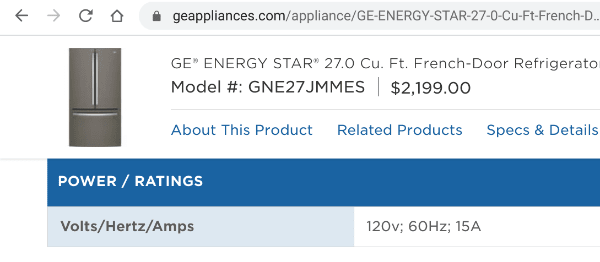
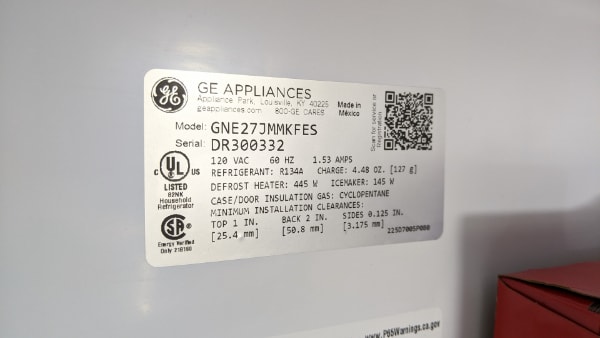
    2. Look inside the door of the refrigerator – an image of mine is below. This will show information like how many volts, amps, and even the wattage of the defrost heater or ice maker.
    3. Find the EnergyGuide label to understand usage for your refrigerator appliance. This has an estimated annual electricity use and cost.
    GE website that shows power with volts, hertz, and amps
    geappliances.com that shows refrigerator specs – power with volts, hertz, and amps

    How Long Will a Refrigerator Run on Solar Panels?

    Depending on the number of solar panels you use to hook up to the fridge, your runtime is going to be affected by how much energy the refrigerator requires to stay cool.

    Think about the needs for a refrigerator to stay cool on a hot day versus a cool day. In hot weather, it requires more energy since it’s being depleted from the heat.

    Three factors that matter for refrigerator runtime

    1. Amount of solar power produced
    2. Battery storage (used when no sun is present)
    3. Power needs from the fridge

    Let’s use the refrigerator in my kitchen as an example. First, the specs:

    • 27 cubic feet 😮
    • 120V
    • 1.53 amps
    • 445W Defrost Heater, 145W Icemaker (we’ll talk about these further down)

    Figure out the refrigerator’s running wattage

    To figure out the total [running] wattage needed, calculate 1.53 * 120 = 183.6 watts.

    Keep in mind that the running watts is different from the surge watts — which the refrigerator requires to start-up or use defrost/icemaker.

    Find out highest need for peak wattage

    Remember the defrost heater and icemaker? For my fridge, we need to calculate the highest amount of energy needed in total, in order to size the solar panels correctly.

    Just to be safe, I’ll add the running watts + defrost heater + icemaker. The numbers are: 183.6 + 445 + 145 = 773.6 watts.

    Here’s a quick calculator to help estimate how many solar panels are needed based on your kilowatt-hours per month.

    Average Refrigerator Energy Consumption Per Year, Month, and Day

    For the estimates here, I used 30 days as a month to get a close count on the daily amount required.

    It always helps me to understand the amount of power (kWh) needed for each day. Sometimes it can help taking it to how much power is needed per hour.

    After starting to compare different refrigerators and their consumption, I decided to stick with Samsung and use different sizes of cubic feet to show a comparison chart.

    Kilowatt hours (kWh) required for three different Samsung refrigerators

    Fridge Size Day Month Year No. of panels
    Power in kWh
    22.6 cu. ft. 1.9 57.5 690 4-6
    27.8 cu. ft. 2.09 62.9 755 4-6
    17.6 cu. ft. 1.23 37.1 446 3-4

    Sometimes breaking down the numbers to the hour is really helpful. If you need to find out how to really compare an hour-by-hour energy consumption vs. production, kWh comes in handy. This can be used by the amount of sunlight the solar panels will get in a typical day.

    Let’s take a look at one of the Samsung refrigerator’s numbers. Looking at the 22.6 cu. ft. option using 1.9 kWh daily, turned into watts first for simplicity.

    1.9 * 1000 = 1900 watts

    Now it’s easier to take 1900 / 3 (hours) to see that we need to produce 633 watts/hour to keep up with the fridge’s [all-day] demands. Since we’re trying to run it for 24 hours, we need to produce a really good amount while we have sun.

    What Else is Needed to Use a Fridge on Solar Panels?

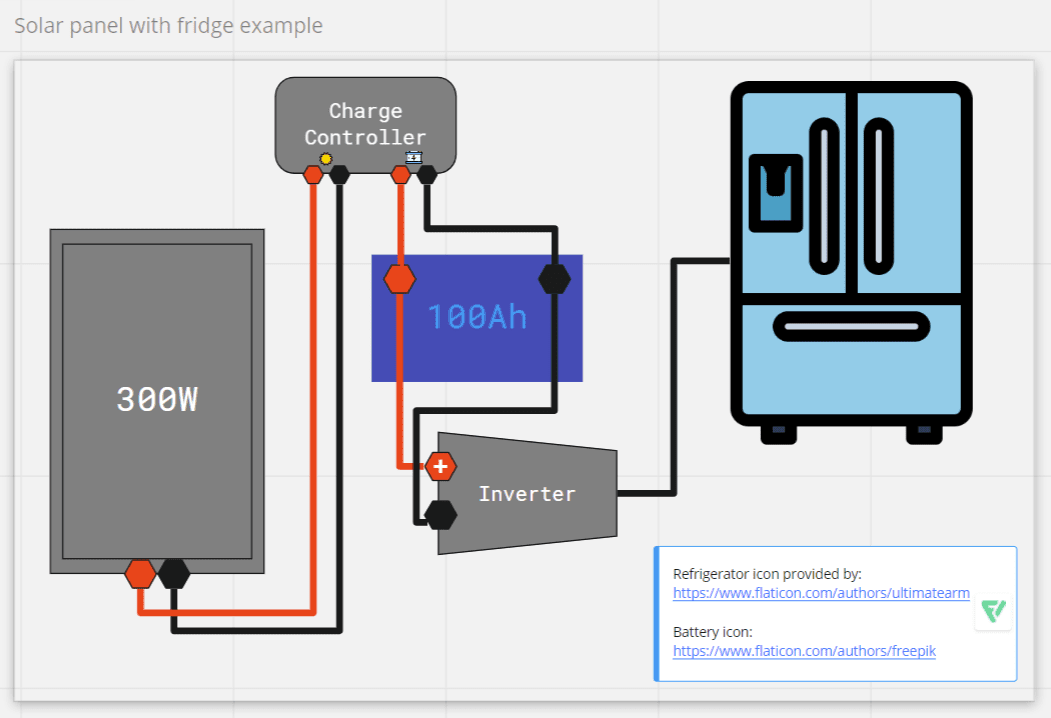
    Going back to our three factors that matter for refrigerator runtime, you will also need other items – a battery that matches the voltage of the solar panel (i.e. a 12V solar panel needs a 12V battery) and some way to connect the battery to the panels – known as a charge controller.

    In addition to both a charge controller and a battery, an inverter is needed to convert the DC to AC so that the refrigerator can be plugged into the power source.

    Solar panel diagram with charge controller, inverter, and refrigerator
    Complete solar panel setup with charge controller, inverter, and refrigerator
    ↗️ Visit my Miro board that contains my work-in-progress solar setup.

    An exception to the inverter is if you are using a 12-volt refrigerator. Sometimes these can be found where RV accessories and equipment are sold or 12V refrigerators on Amazon.

    You might consider using a DC fridge compared to AC if you’re trying to minimize energy loss and be more efficient.

    Newer technology like the ACOPOWER LiONCooler Rechargeable Solar Fridge Freezer come with a battery included! So the only thing you’ll need to hook-up to it is a solar panel. They do also have a model that has a battery AND a solar panel.

    Factors to Consider When Sizing a Solar Set-up for a Refrigerator

    There are other things to keep in mind when it comes to sizing how many solar panels you will need. Since people have different habits, these habits will affect the longevity of the fridge.

    Let’s review a few items that affect the power need:

    • Opening and closing a fridge door constantly will affect the demands for power.
    • The amount of food inside will actually help stay cooler longer given that the door remains closed and heat doesn’t come in.
    • Whether the refrigerator has a freezer or not

    Does a Refrigerator Maintain Consistent Power on Solar Panels?

    A refrigerator changes based on the conditions around it and may not need to turn on or off as often. An air compressor and ambient room temperature will affect the length of time for internal cooling.

    How Much Energy Does an Average Refrigerator Use?

    19-21 cubic feet is the measurement for your typical fridge. Most families fall into the 21+ range to accommodate enough food for everyone. Here’s an entire article amount determining the amps for a fridge.

    How Does a Refrigerator Run on Solar Panels?

    Solar panels take the energy from the sun in the form of DC (direct current) and use it to run power to a refrigerator.

  • What Is A Solar Power Battery Bank?

    Having a solar system can definitely minimize energy consumption on the grid. But when the sun goes down, using a battery bank is the solution to continue using solar after-hours.

    A solar battery bank is an energy storage solution that creates a way to use solar panels when the sun is not available. The battery bank connects more than one battery to allow for more storage capacity or higher voltage depending on your needs.

    A created battery banks helps with a true self-sustaining cycle of electricity use. You don’t have to worry about going “back to the grid” when darkness hits just because the sun went away.

    Thinking about wiring batteries can be intimidating, but it doesn’t have to be! Taking the right precautions and truly understanding how batteries work for solar will help reap the benefits of your solar production.

    How Does a Solar Battery Bank Work?

    The idea behind a “bank” of batteries is to collectively join more batteries together in order to increase one of two things: voltage or amps.

    To throw some battery terminology in the mix, let’s talk about series and parallel connections.

    Series Battery Wiring: Connection and Diagram

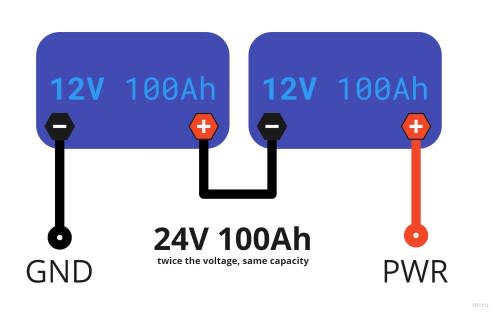
    two batteries wired in series connection
    12V 100Ah batteries wired in series diagram

    Wiring batteries in series will increase the voltage. This obviously depends on the number of batteries used, but the principal remains.

    As an example, with two 12V batteries with an amp-hour rating of 100, connecting two batteries together results in a 24V battery.

    When batteries are connected, they don’t really have a smart memory. In any order they are connected, the source and ground connections remain like a single battery.

    Parallel Battery Wiring: Connection and Diagram

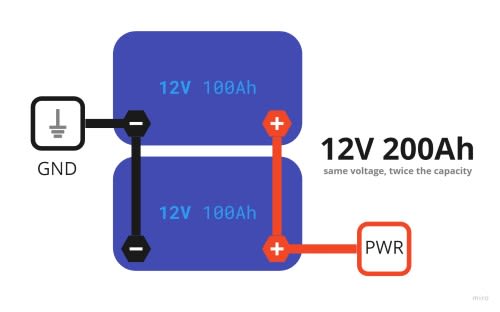
    two batteries wired in parallel connection
    12V 100Ah batteries wired in parallel diagram

    Wiring batteries in parallel will create more capacity. No matter how many batteries are used, the capacity adds together.

    For an example on a parallel battery connection, the same 12V batteries with an amp-hour rating of 100 wired in parallel will result in 200Ah  (100Ah+100Ah) capacity.

    Refer to the battery bank tutorial on batterystuff.com website for more information on these types of connections.

    FAQs

    How does a solar battery bank work?

    How is solar energy stored in batteries? Solar batteries work by storing energy produced by your solar panels for later use. In some cases, solar batteries have their own inverter and offer integrated energy conversion. The higher your battery’s capacity, the more solar energy it can store.

    What is a battery bank for solar energy?

    The battery bank means several batteries with parallel and series connection set up into an energy storage bank, which store solar energy from solar panel and provide electricity to loads via DC-AC inverter. Battery bank is core item in a solar power system as an energy storage.

    How long will a solar battery bank last?

    The general range for a solar battery’s useful lifespan is between 5 and 15 years.

    Are solar powered power banks any good?

    In short, solar power banks and portable solar chargers offer convenience for the consumer. While they are energy-efficient, they may not always be a money-saving option. So, their worth will largely depend on their application and consumer preference.
    Source: https://solarpowergenie.com/are-solar-power-banks-worth-it/

    Is it worth getting a solar battery?

    The value of a solar battery depends on preference. If living with an off-grid type of setup, it will definitely be worth the cost and time to setup the battery so energy can be used without the sun.

    If you are just trying to offset the cost of grid electricity with solar panels, it’s possible having a solar battery will be more work than benefit.